Nursery Organisation Ideas: The Realistic Guide for New Moms
Here’s the thing nobody tells you about nursery organisation: the beautiful, colour-coordinated nurseries you see on Pinterest were photographed before the baby arrived. Real nursery organisation isn’t about looking perfect — it’s about being able to find a clean sleepsuit at 3am, one-handed, in the dark, without waking anyone up.
This guide covers everything: how to set up each zone of the nursery, systems for the never-ending flow of baby clothes, what storage is actually worth buying, and how to make it all work in a small or rented space. Whether you’re nesting at 34 weeks or trying to bring order to chaos six months in, start here.
The One Rule That Makes Everything Easier
Before we get into specific nursery organisation ideas, one principle underpins all of them: organise for the tired version of yourself.
Every system in the nursery should pass what I call the 3am test — can you use it half-asleep, with one hand, without turning the big light on? If a system needs two hands, good lighting, or any thinking at all, it will collapse within a fortnight. Pretty is optional. One-handed is not.
Grab your free
Chore Chart printable
Turn everyday jobs into a star-earning game the kids actually want to do. Pop your email in and it lands straight in your inbox, plus weekly home-organisation tips for busy moms.
No spam, ever. Unsubscribe anytime.
Zone 1: The Changing Station
The changing area is the most-used spot in the nursery for the first year, so it earns the most organisation effort.
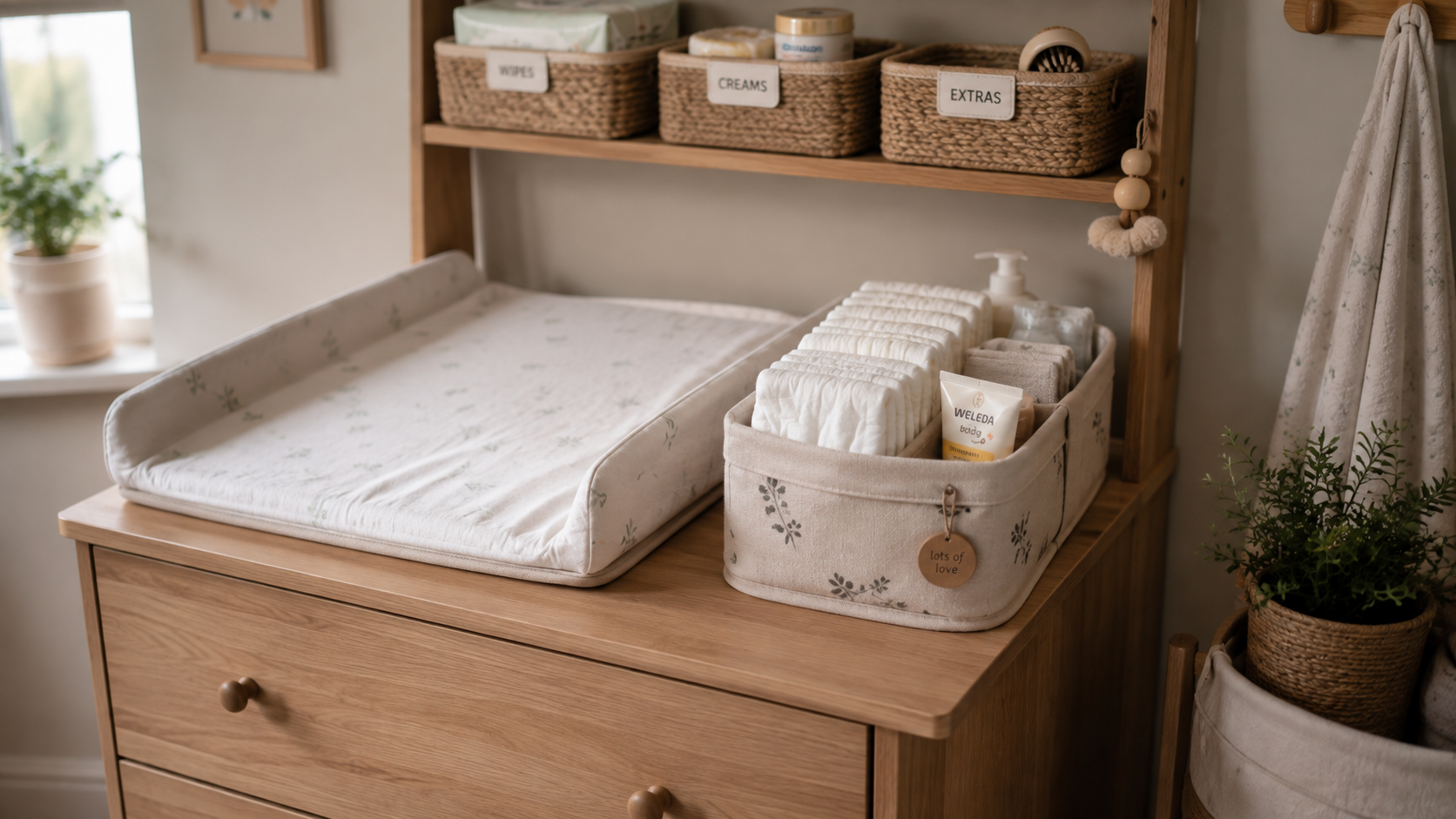
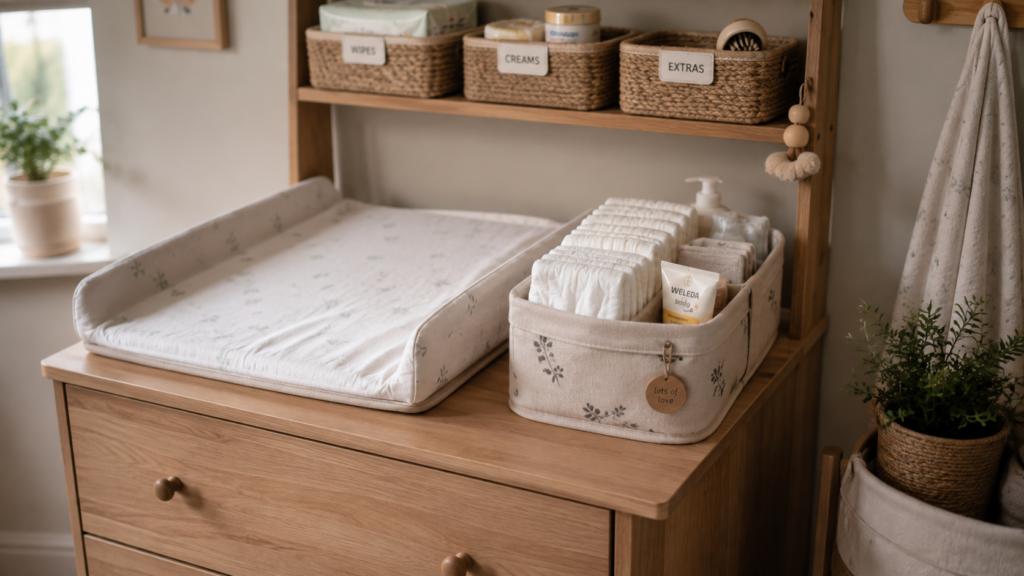
Everything within arm’s reach. You can never step away from a baby on a changing table, so nappies, wipes, cream, a spare outfit, and a muslin all need to be reachable without moving your feet. A changing table with open shelves underneath, or a chest of drawers with a caddy on top, both work.
Use a nappy caddy — and make a second one. A portable caddy with nappies, wipes, cream and a change mat means you’re not marching upstairs for every change. Keep one at the changing station and a duplicate wherever you spend your days — the living room, usually. This single duplication saves more time than any other tip in this guide.
Restock as a routine, not a rescue. Refill the caddy and changing station every evening as part of shutting the house down. Discovering you’re out of wipes during a change is a rite of passage you only need once.
Decant nappies by size. Keep only the current size at the changing station. Store the next size up (and outgrown spares to pass on) elsewhere, clearly labelled — nappy size changes sneak up on you.
Zone 2: Baby Clothes (the Real Boss Battle)
Baby clothes multiply. Between gifts, hand-me-downs and the fact that babies outgrow things in weeks, clothing is where most nurseries lose the battle. These baby room organisation systems keep it in check:
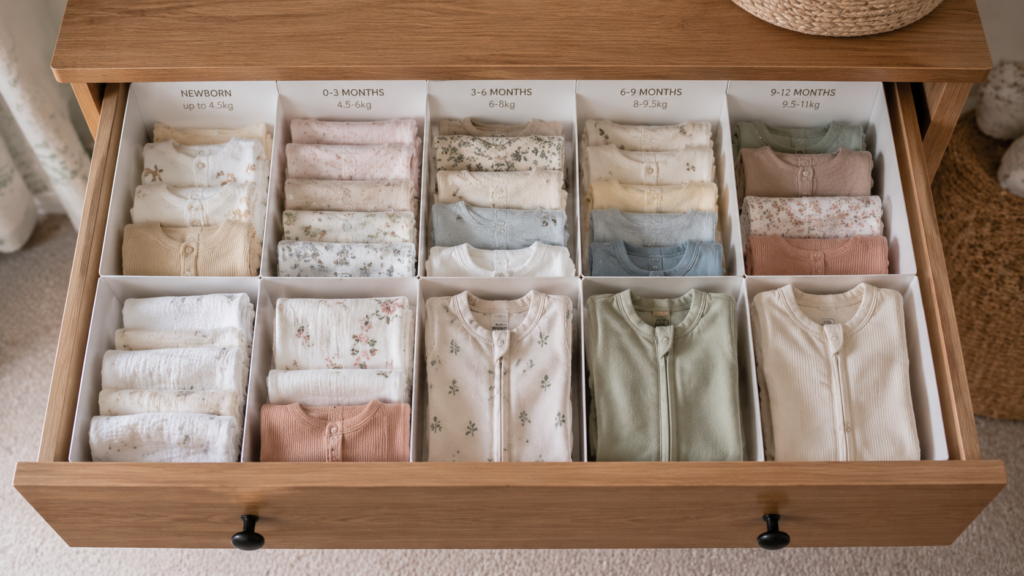
Organise by size, not by type. Forget sorting into “tops” and “bottoms” — sort by age size (newborn, 0–3, 3–6, 6–9, and so on). Only the current size lives in the accessible drawers. Everything else goes into labelled boxes: one “next size up” box somewhere easy to reach, and sealed boxes for anything beyond that.
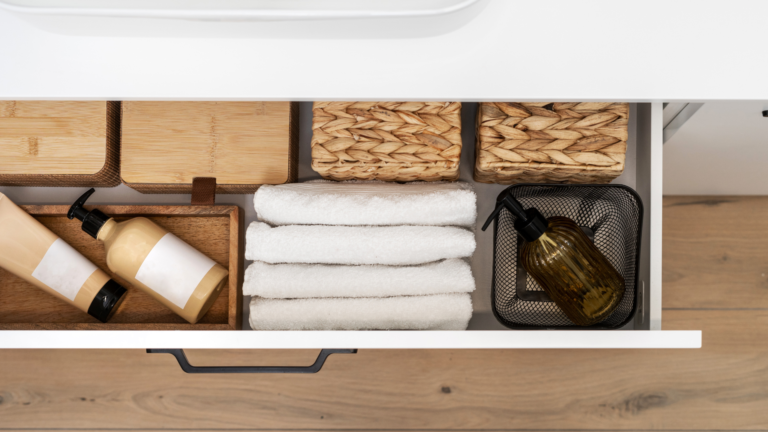
Drawer dividers are the single best purchase. Small clothes turn into drawer soup without them. Dividers (or small open boxes inside drawers) give sleepsuits, vests, socks and hats their own lanes, so a one-handed grab doesn’t wreck the whole drawer.
File-fold, don’t stack. Folding clothes upright, file-style, means you can see every item at a glance and pull one out without disturbing the rest. It sounds fussy; it takes the same time as stacking once it’s habit.
Run a permanent outgrown box. Keep an open box or basket in the wardrobe labelled “outgrown.” The moment something no longer fits, it goes straight in — no decision, no pile on the floor. When the box is full, sort it once: keep for a sibling, pass on, sell, or donate. This one habit prevents the classic new-mom experience of a wardrobe that’s 60% clothes the baby can’t wear.
Hang the outfit-ish things, fold the rest. Hanging space is best used for the small number of “proper” outfits, coats and pram suits. Everyday sleepsuits and vests live folded in drawers where they’re faster to grab.
Zone 3: Feeding and Night-Time Supplies
Whether you’re breastfeeding, bottle-feeding or combination feeding, the nursery needs a small night-time supply zone near the chair or cot.
A small basket or bedside caddy with muslins, burp cloths, nipple cream or bottle bits, a water bottle and snacks for you, and a dim night light covers the essentials. The goal is never leaving the room mid-feed.
If you’re bottle-feeding, most of the kit lives in the kitchen — but a small insulated flask setup or ready-to-feed cartons stationed in the nursery can save the 2am stairs trip. Work out your own night routine first, then station supplies to match it, not the other way round.
Zone 4: Toys, Books and the Stuff That Isn’t Here Yet
In the newborn months, toys barely exist — but they’re coming, and building the system now beats retrofitting it later.
One basket, visible; the rest, rotated. Babies and toddlers play more with fewer toys. Keep one small basket of toys out, and store the rest in lidded boxes. Every week or two, swap them. (Toy rotation deserves its own post — [internal link: Toy Rotation & Decluttering with a Toddler] — but the nursery version is simply: most toys live in the cupboard.)
Front-facing book storage. A small front-facing rail or ledge shelf shows book covers rather than spines. Babies choose books by picture, and it doubles as wall decor. A basket of board books at floor level works just as well in a pinch.
Leave empty space on purpose. The most common nursery mistake is filling every shelf before the baby arrives. Kit accumulates at a frightening rate in year one — an empty shelf or drawer now is a gift to your future self.
Small-Space and Rented-Home Nursery Ideas
No separate nursery? A corner of your bedroom, or a shared room with a sibling, organises on exactly the same principles — just vertically.
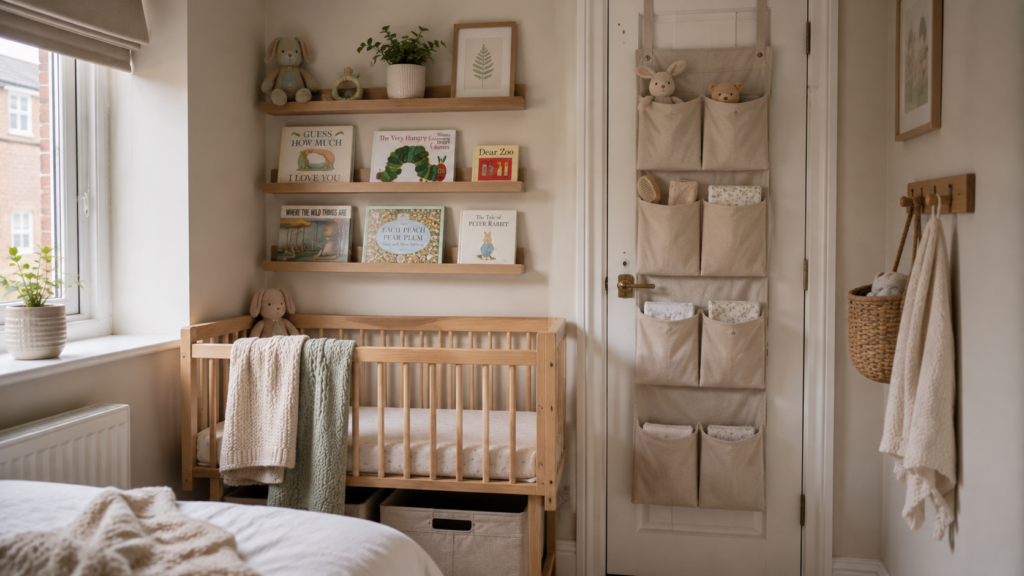
- Go up the walls (with removable fixings if you’re renting): ledge shelves, hanging organisers on the back of doors, and wardrobe-door caddies add storage without floor space.
- Under-cot storage boxes are ideal for the sealed “next size up” clothes and spare nappy stock — things you need monthly, not nightly.
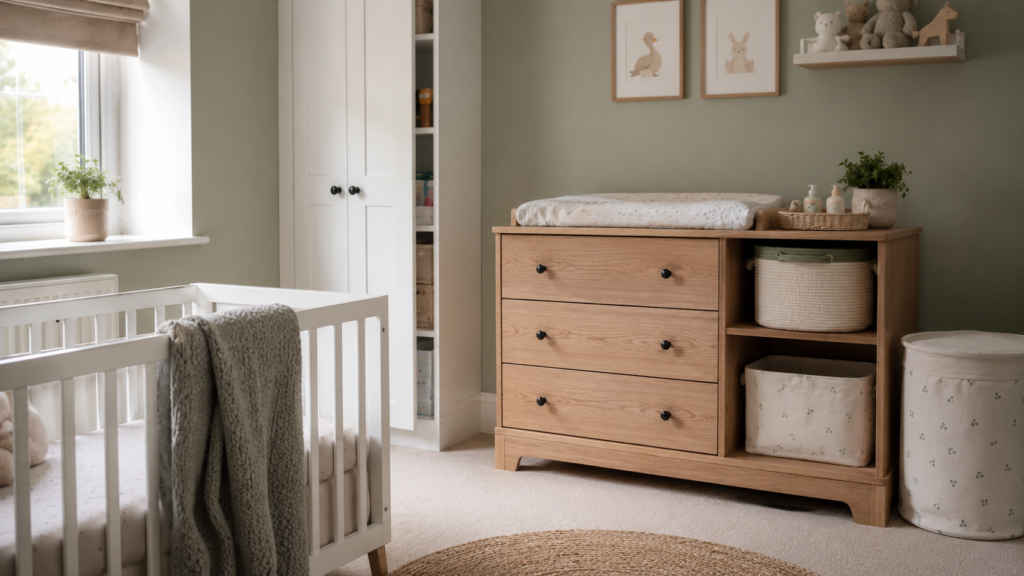
- A chest of drawers with a change mat on top replaces a dedicated changing table and keeps earning its keep long after the nappy years.
- Choose furniture that converts — cots that become toddler beds, changing units that become ordinary drawers. In a small space, single-use baby furniture is the enemy.
The Nursery Organisation Checklist
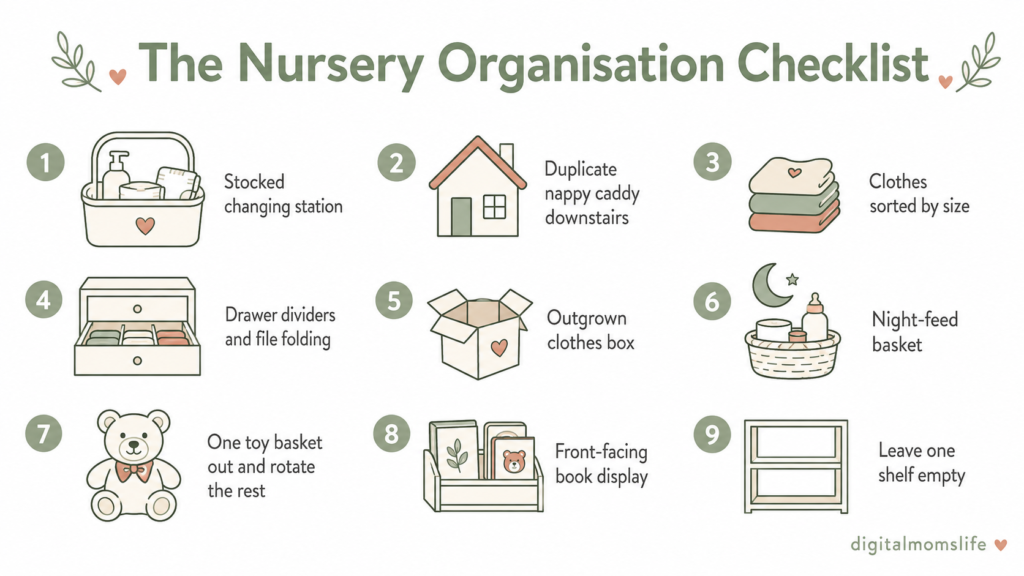
Pin the infographic above, or run through the quick version:
- Changing station stocked, everything reachable one-handed
- Duplicate nappy caddy stationed where you spend the day
- Clothes sorted by size; only the current size in daily drawers
- Drawer dividers in, clothes file-folded
- “Outgrown” box open and in use
- Night-feed basket by the chair
- One toy basket out, the rest boxed for rotation
- Books front-facing at baby height
- At least one shelf or drawer left deliberately empty
Keep It Running: The Five-Minute Reset
Organisation isn’t a one-off project; it’s a tiny daily habit. Each evening — or honestly, whenever the baby naps and you have five minutes — restock the caddies, drop outgrown clothes in the box, and return strays to their zones. Five minutes daily beats a three-hour blitz monthly, every time.
And when a system stops working? Change the system, not yourself. If the sleepsuits keep ending up in a heap, the drawer is set up wrong — you’re not failing. The nursery should adapt to how you actually live with your baby, week by week.
You’ve got this — one drawer at a time.