Setting Up a Well Designed Playroom For Creativity and Learning
If your living room floor currently doubles as a toy minefield, this one’s for you. A well-designed playroom isn’t about a Pinterest-perfect space with colour-coordinated everything — it’s about a room (or corner) that your kids actually want to play in, and that resets in ten minutes instead of an hour.
This guide is part of our complete guide to organizing your home, and it’s built for real life: toddlers who dump every basket, rented homes where you can’t repaint, and budgets that don’t stretch to built-in cabinetry.
Start With Zones, Not Furniture
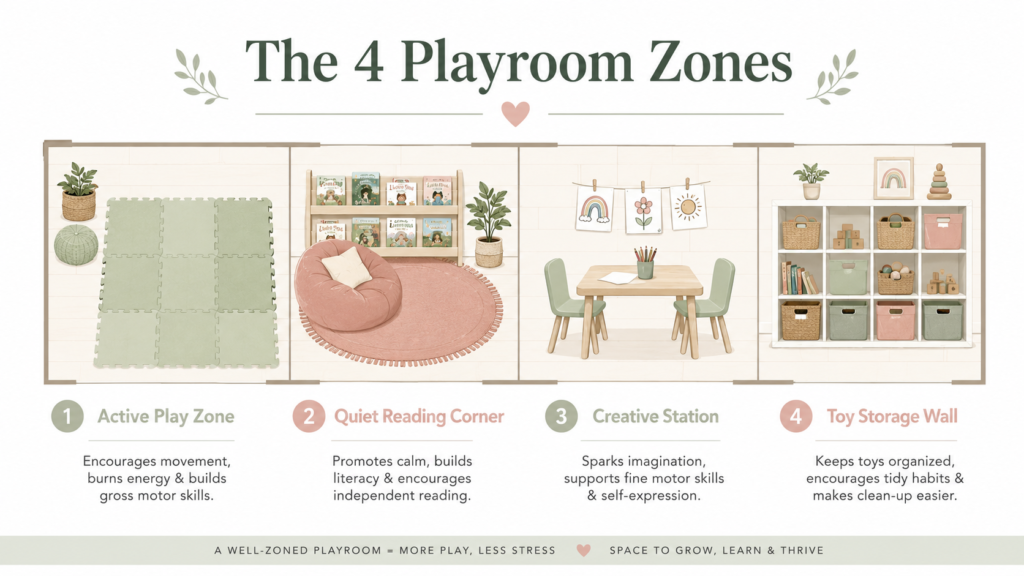
Before you buy a single storage cube, divide the space into zones. Zones do the organising for you, because everything has an obvious home:
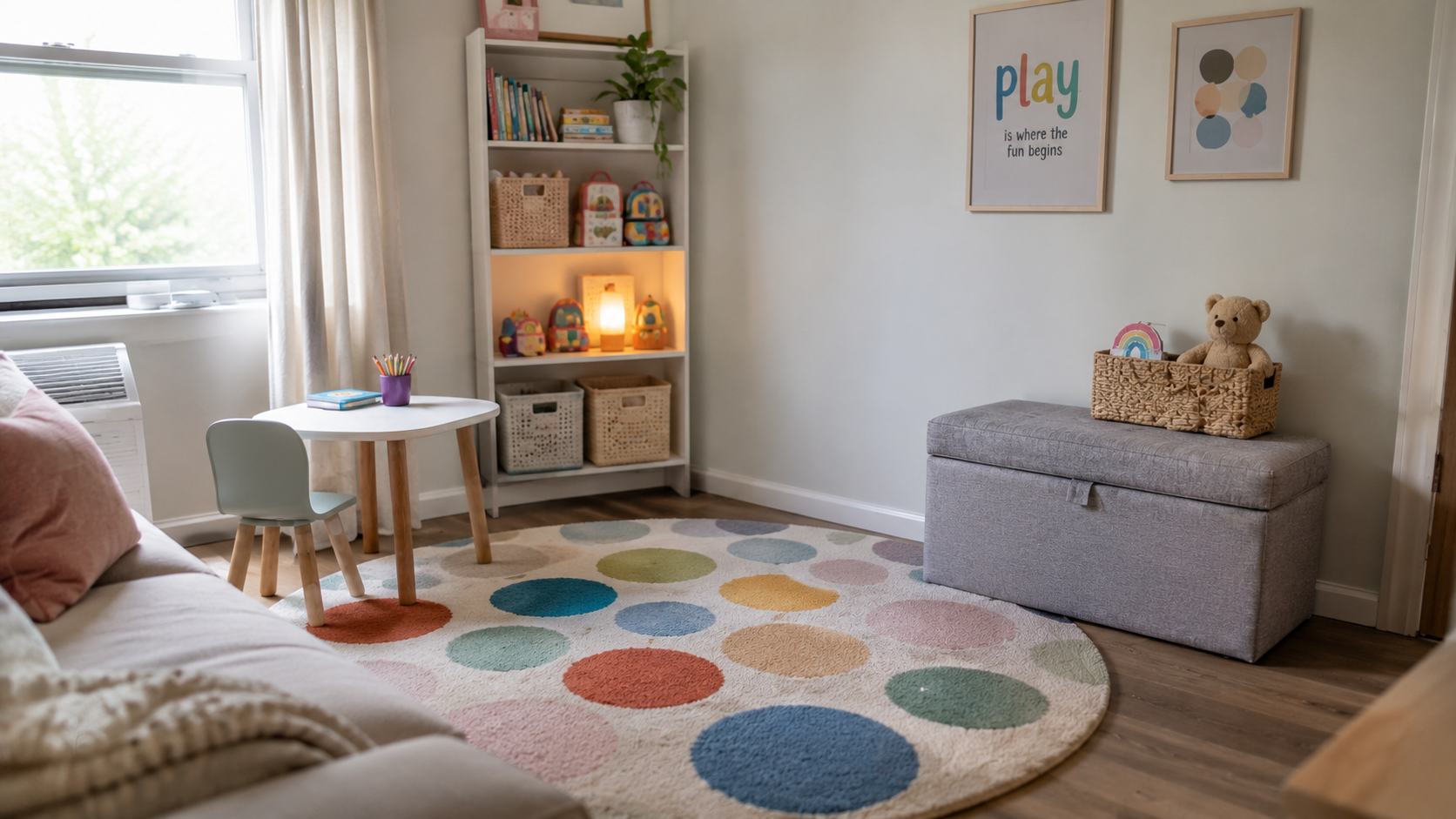
- Active play zone — the biggest open floor area, kept clear for building, dancing, and general chaos. A washable foam play mat or rug defines it visually.
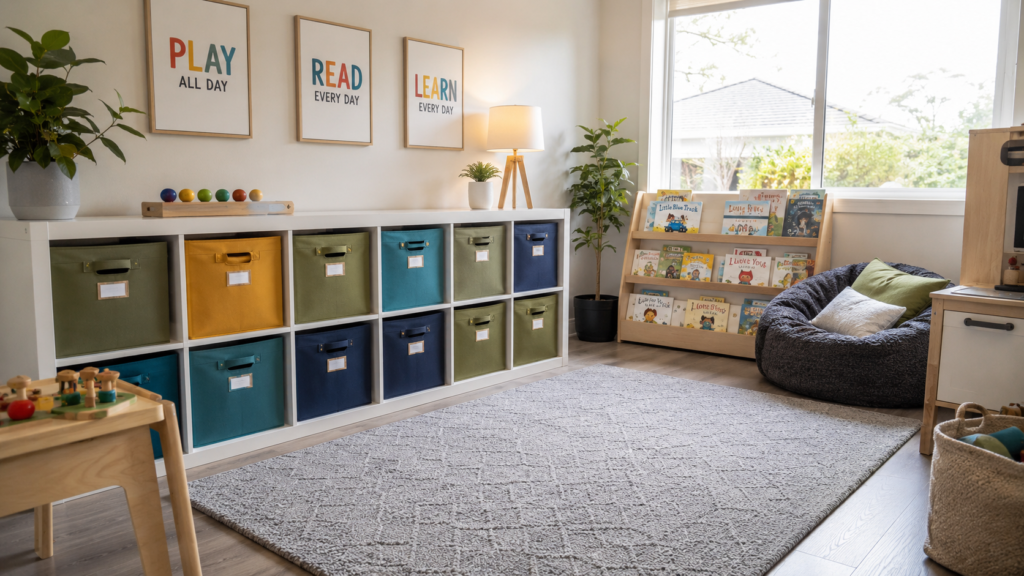
- Quiet corner — a small reading nook with a front-facing book display, a beanbag or floor cushions, and soft lighting. Front-facing book storage matters: toddlers pick books by cover, not spine.
- Creative station — a small table and chairs for drawing, play dough, and crafts. Keep messy supplies up high in a lidded caddy you bring down on request.
- Toy storage wall — one wall (or one unit) where all toys live. Containing storage to a single area stops the whole room becoming storage.
If you’re working with a corner of the living room rather than a full playroom, pick just two zones: active play plus the storage wall. The same principles scale down.
Grab your free
Chore Chart printable
Turn everyday jobs into a star-earning game the kids actually want to do. Pop your email in and it lands straight in your inbox, plus weekly home-organisation tips for busy moms.
No spam, ever. Unsubscribe anytime.
Toy Storage That Toddlers Can Use
The golden rule: if your child can’t put it away themselves, the system will fail. That means:
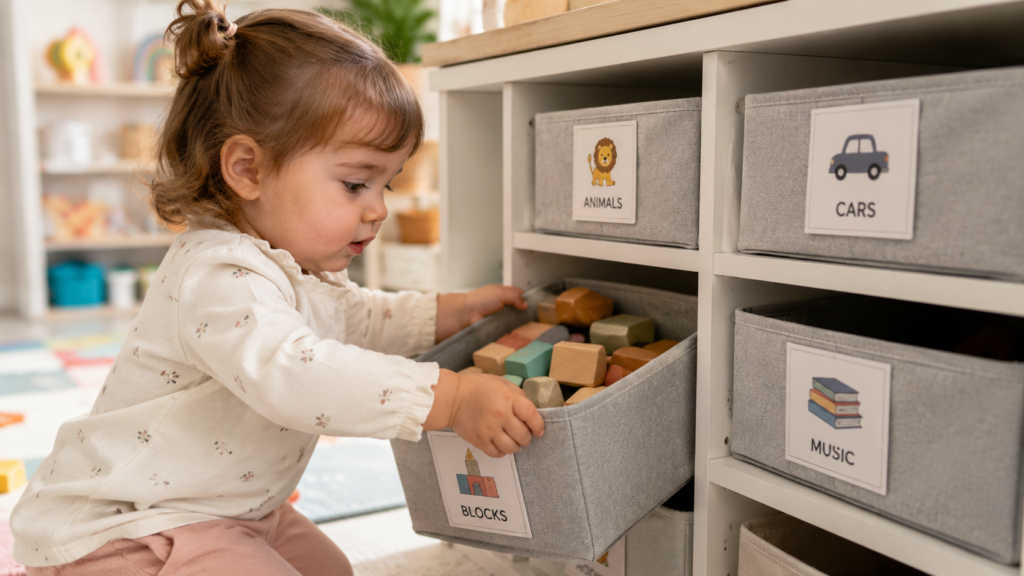
- Low, open cube shelving rather than deep toy boxes. A big toy chest is where toys go to be dumped out and forgotten; shallow bins on low shelves let kids see and reach everything.
- One category per bin. Cars in one, blocks in another, dolls in a third. Toddlers can sort by category long before they can “tidy up” in the abstract.
- Picture labels. Print or draw a simple picture label for each bin so pre-readers know where things belong.
- A “too many pieces” shelf up high for puzzles, games, and anything with 500 tiny parts. These come down one at a time, with you.
Toy Rotation: The Secret Weapon
Here’s the counterintuitive truth every mom learns eventually: fewer toys out means more play, not less. When every toy your child owns is visible at once, they flit between things and play with nothing.
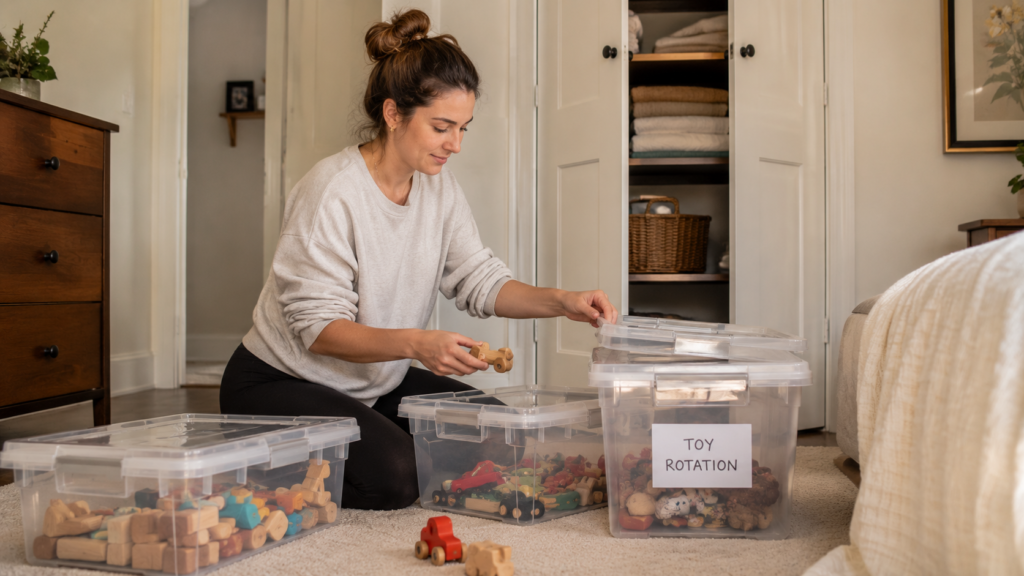
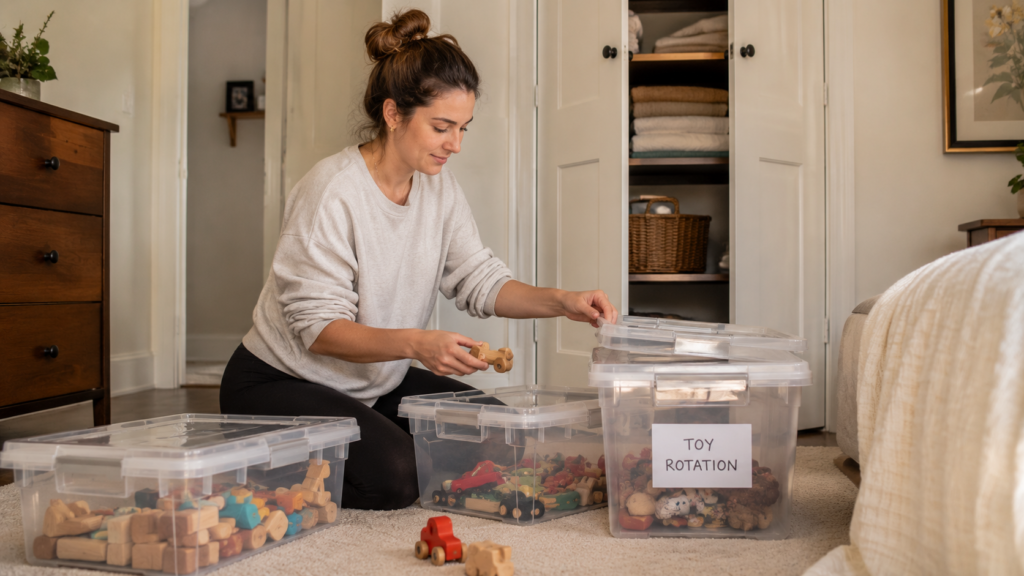
Keep roughly a third of the toys out, and box the rest up out of sight — under a bed, in a wardrobe, in labelled lidded boxes in the garage. Every few weeks, swap. “Old” toys come back like brand-new ones, and your storage wall never overflows.
Rotation also makes decluttering painless: anything that comes out of the box to zero excitement twice in a row is a donation candidate. For the full method, see our room-by-room decluttering guide.
Small Spaces, Rented Homes, and Shared Rooms
No dedicated playroom? Most young families don’t have one. What works:
- Vertical storage — wall-mounted shelves and over-door organisers use height instead of floor space. In a rental, freestanding tall units (safely anchored with removable straps where possible) do the same job without drilling.
- Furniture that hides toys — storage ottomans and benches let a living room switch back to adult mode at 7pm.
- A rug as the “playroom” — in a shared space, the play zone is wherever the play rug is. Toys stay on the rug; when the rug is clear, tidy-up is done. Toddlers understand edges better than instructions.
- A folding play mat that packs away turns any room into the active zone temporarily.
Safety Basics (Two Minutes, Non-Negotiable)
- Anchor every shelf and unit to the wall — cube units are climbing frames as far as toddlers are concerned.
- Choose lidless bins or slow-close lids; no slamming toy-chest lids.
- Keep cords, blinds pulls, and plug sockets out of the play zones.
- Soft flooring (foam tiles or a thick rug) under any climbing-height furniture.
The 10-Minute Evening Reset
A well-designed playroom is one you can reset while the kettle boils:
- Everything back to its labelled bin (kids do this part — make it a race).
- Books face-out on the display shelf.
- Craft table wiped, supplies back in the caddy.
- One quick scan for anything broken or ignored → donation box.
That’s it. The design does the work; the routine just maintains it.
Before You Go
A playroom that works isn’t the prettiest one — it’s the one your child can use independently and you can reset without resentment. Start with zones, keep storage low and labelled, rotate the toys, and let the room earn its keep.
Want the shortcuts? We’re putting together printable picture labels for toy bins and a toy rotation tracker — keep an eye out.